


Construction
Focused on the green circular economy, HRC leverages patented recycling technologies to drive the use of recycled carbon fiber in the construction sector.

-
Fully Recyclable Construction System
This green, low-carbon, lightweight CF construction formwork is made by recycling and decomposing waste CF composites, followed by secondary processing. The product features lightweight, high strength, corrosion resistance, and long lifespan. After 200 to 300 uses, it can be remanufactured and reused, achieving benefits such as saving building materials, improving molding quality, and reducing labor costs. This supports high recycling and zero-emission goals in the construction industry
-
-
Recycled Carbon Fiber Formwork
rCF formwork are available in customizable dimensions and are primarily manufactured from low-carbon recycled carbon fiber. The fiber filaments are clearly visible, reflecting the material's authentic composite structure. All formwork have been certified by internationally recognized third-party testing organizations, covering comprehensive performance evaluations such as mechanical properties, stiffness, and fire resistance.
With a flexural modulus exceeding 8 GPa and a flexural strength above 60 MPa, the formwork delivers outstanding structural performance. Compared with conventional timber form-work, carbon fiber does not chemically interact with cement concrete. its high dimensional precision ensures superior concrete finishes, resulting in smooth surfaces,uniform coloration,and defect-free appearance after demolding.
-
-
Tunnel Formwork Trolley System
The HRC tunnel formwork trolley utilizes recyclable carbon fiber formwork panels, offering lightweight construction, high strength, corrosion resistance, superior concrete finish, and high construction efficiency. Compared with conventional steel formwork, the system achieves a weight reduction of approximately 60-70%, effectively lowering trolley driving energy consumption.
Carbon fiber formwork is an inert,non-absorbent material with excellent resistance to corrosion and rust, making it suitable for moist and chemically aggressive tunnel environments. After demolding, the concrete surface exhibits improved smoothness and finish. The smooth panel surface, low thermal expansion coefficient and precise formwork release control reduce the need for secondary surface repairs. Due to the low selfweight of the formwork, assembly and dismantling time is reduced by more than 30% The lightweight components facilitate manual handling and significantly increase the number of reuse cycles
-
-
Single Side Formwork System
The system features high safety performance and mobility, and is suitable for single-sided wall formwork construction where lifting equipment is unavailable. The main structure of the single-sided support system adopts a trapezoidal truss design, providing high overall stability and strength. Optional universal wheels can be added t o reduce the frequency of installation and removal of the formwork and supporting frames.
Key advantages include rapid construction, high safety, no need for lifting equipment, simple workflow, strong operability, reduced labor hours, high material utilization, good surface quality, and effective waterproofing. The system effectively addresses issues common to traditional station-side wall construction, such as high labor and time consumption, low material efficiency, poor surface quality, and water leakage. It is suitable for cut-and-cover, mined tunneling, and similar construction methods, and has been widely applied in subway and tunnel projects
-
-
Composite I-Beam
The composite l-beam is a pultruded product made from an epoxy resin and glass fiber composite material. The composite l-beam serves as a high-performance alternative to traditional wooden and aluminum I-beams. Produced via pultrusion with epoxy-glass reinforcement, it is engineered for critical infrastructure projects including hydroelectric dams, bridge decks and nuclear containment structures Click here to learn more
-



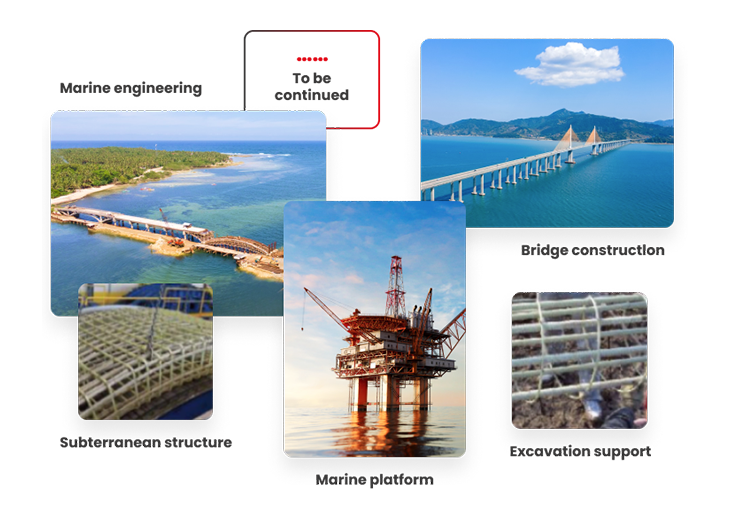
HRC's Glass Fiber Reinforced Thermoplastic Polymer Rebar (GFRTP Rebar) is an innovative material specifically designed for marine engineering. Crafted with precision, we have successfully developed this new generation of alternative products. Excelling in marine environments, this material boasts exceptional corrosion resistance. Its composition of glass fiber not only ensures lightweight properties but also delivers outstanding strength, elevating performance and offering greater design flexibility for projects. Moreover, we are committed to providing customized solutions tailored to meet the unique requirements of various marine engineering projects.